|
‘Prakriti’, the Environment Society of Lady Shri Ram College invites applications for the first Lady Shri Ram Model Conference of the Parties (LSR MCOP) to be held on 26th March 2011 during its environment festival, ‘Prakriti Week’ (21st-26th March 2011). http://www.facebook.com/event.php?eid=157058624348045#!/event.php?eid=157058624348045¬if_t=event_wall#wall_posts• Applications are open for the following positions:1. Govern...ment Delegates for the Ad Hoc Working Group on Long-term Cooperative Action (AWG-LCA)
Agenda: ‘Sustainable Development through Adaptation to and Mitigation of Climate Change’
2. Media Delegates (choose one of the three positions):
a) Chief Editor (1)
b) Reporter (3)
c) Photographer (1)
3. NGO Delegates (4)
For whichever delegate position you are applying, please write 250 words on why you want to be a part of LSR MCOP, and what makes you a suitable candidate for the position you are applying for (if you are applying to be a Media Delegate please include relevant samples of your work).
Additionally, please mention previous debating and/or MUN experience. Please note however that we will welcome those with no prior experience as well.
Send in the above (on or before 13th March 2011) to lsr.prakriti@gmail.com along with the following details:
Name, College, Course, Year, Email Address, Phone Number, and Top Three Country Preferences* (in case you are applying to be a Government Delegate)
*Countries:
China, Maldives, Australia, Russia, United Kingdom, Bolivia, Bangladesh, Egypt, Nigeria, Sweden, Saudi Arabia, Canada, Mexico, Indonesia, United States of America, Brazil, South Africa, Haiti, India, Afghanistan, Japan, Chile, United Arab Emirates, Congo, France, Turkey, South Korea, Malaysia, Iran, and Norway.
• Applications are also open for the Executive Board of the (AWG-LCA). It is mandatory for applicants to have had prior Executive Board experience. Knowledge about UNFCCC and Conference of the Parties is also a must. Positions are:
a) Chair
b) Vice- Chair
For whichever Executive Board position you are applying, please write 250 words on why you want to be a part of LSR MCOP, and what makes you a suitable candidate for the position you are applying for.
Please also mention previous debating and/or MUN experience.
Send in the above (on or before 13th March 2011) to lsr.prakriti@gmail.com along with the following details:
Name, College, Course, Year, Email Address, Phone Number
Prizes:
Best Delegate: Rs. 2,000
High Commendation: Rs. 1,000
Special Mention: Rs. 500
Queries, if any, may be addressed to lsr.prakriti@gmail.com.
LSR came alive with vibrant colours and festivity on 1 st November, 2010. The shift from the boring classes to jubilant exultation, was to celebrate the festival of lights i.e. diwali. The traditional festival of lights with its significant message of victory of good over evil was celebrated with great pomp and show. Every year the celebration is earmarked by a small diwali mela organized by the NSS (National Social Service Organization) of LSR. The mela was a happy affair with its assortment of food, games, accessories and the like. The presence of Rajasthan dancer’s, Punjabi dhol and a street play group left nothing else to be desired for. The festive mood was in full swing with every stall thronged by girls dancing either to the tune of Punjabi pop or Eminem rap. Apart from the stall’s set up by the NGO’s under the NSS, the different societies of LSR had also set up their respective stalls.
Entretia, the e- cell of LSR had also set up a stall at the diwali mela. Our stall was placed conveniently in the mela so as to capture more eyeballs, sell more products and hence earn more profit. The item’s exhibited for sale at our stall were cool flat chappals, assorted candies’, cloth bags, eco-friendly and multipurpose vase and customized posters. This was not all as there was also a betting game which required the individual to complete the task without tearing the paper given to the individual. Every member of the e-cell contributed in the successful sale of the items in the stall in their own way. For instance, some had taken up the duty of taking charge of the stall and persuading the customer’s into buying the items for sale at the diwali mela. The items were sold at “customer pocket friendly prices” like one pair of chappals for 130 rupees, bag for 165 rupees, and vase for 15 rupees and so on. This was the primary reason for the voluminous sale of our items at the diwali mela.
This effective pricing strategy helped us in earning profit and increasing the immensity of this festivity. The success of the event should also be attributed to all the members of the e-cell who volunteered and worked as a team under the praiseworthy leadership of the e-cell coordinator’s Smriti and Swati.
I often go to Majnu Ka Tila after college it’s quite and not crowded, very unlike most of Delhi. It feels good to be there, specially the café at the very heart of ‘MT’ as we fondly call it! Even after having innumerable cups of coffee and the street side treat laping, I had never thought that the same place would one day turn out to be the home of a hero who sacrificed his life for his people, for his country and most importantly for ‘Freedom’. I am talking about Jhampel Yeshi, a 27-year-old Tibetan living in exile in India, set himself aflame at a protest on 26th March 2012 in New Delhi against the forthcoming arrival of Chinese President Hu Jintao. It was at least the 30th time a Tibetan had self-immolated this year alone, a shocking statistic. But as Yeshi’s fiery protest took place in India - rather than in Tibetan areas of China, where most of the immolations have occurred - it received more coverage by the press.
Yeshi died from his injuries a day later, prompting more demonstrations by Tibetans in India against what they consider the brutal Chinese occupation of their homeland. The Indian government, nervous about upsetting China, engaged in a full-on crackdown, arresting close to 300 Tibetans on an archaic colonial law that wards against such dissent.
Yeshi before self immolating left a poignant hand written note. He wrote, ‘the fact that the Tibetan people are setting themselves on fire in this 21st Century is to let the world know about their suffering.’ The number of Tibetan self immolations in China has crossed over thirty. But is the world listening?
Soon after the incident as usual the Chinese authorities put the blame on the Dalai Lama. The Chinese Foreign Ministry spokesperson Hong Lei accused the Dalai Lama of ‘masterminding’ the series of self immolations. The Chinese officials also ‘complimented’ the Indian authorities for their ‘handling’ of the situation. Apart from officials, not many in India would be enthused to receive such a compliment!
And yet the Chinese refuse to take a second look at what is actually causing such unrest in Tibet. Areas inhabited by Tibetans are under harsh security cover. Many new road check points have been built and they are manned by heavily armed Para-Military Police. The Chinese have also instituted ‘monastic management’ plans in order to control religious life. About 21,000 Chinese officials have been deployed to ‘befriend’ Tibetan monks and dossiers have been created on most of the latter. In addition, over a million national flags and Mao portraits have been distributed; monasteries have to compulsorily hang Mao portraits. Such heavy handedness is causing great disaffection amongst the general Tibetan population.
Sadly for the Tibetans, apart from human rights activists, no country has spoken up for them or for their obvious suffering. When a Tunisian street vendor Mohamed Bouazizi self immolated in Tunis on 17 December 2010, he actually helped launch the so-called ‘Arab Spring’ which led to widespread changes in the Arab World. Unfortunately for Jamphel Yeshi, nothing similar seems to have happened in Tibet. Even when the Chinese occupied Tibet in 1950 and the Tibetans took their case to the UN, no major country including Nehru’s India supported their case. While most are demonstrably anxious about the goings on in Syria and critical of the killings of innocent civilians there, few if any are prepared to shed a tear for the hapless Tibetans.
The reasons are not far to seek. No one wishes to annoy the Chinese. The People’s Republic of China is a permanent member of the UN Security Council. It is the second largest economy in the world after the United States and of recent has also grown considerably in military might. Western countries which used to raise Tibet as an issue in their relations with China now also appear to overlook or bypass it when dealing with China.
On the eve of the anniversary of the failed 1959 Tibetan uprising, mass protests were launched by Tibetans and their support groups from their exiled capital Dharamsala, India. Hunger strikes, Candle light vigils, remonstrations and public anger were witnessed in every Tibetan community across the world.
Lobsang Wangyal, an exiled Tibetan entrepreneur living in India says, "Tibetans in Tibet have long said they are not happy under Chinese rule. The self-immolations are saying that they mean it. But the world is paying little attention. It gives a feeling that 30 Tibetans risking their lives is still not enough to make a point and as if more lives should be sacrificed."
However, all is not lost for the Tibetans. With the evolution of the new media and social networking websites such as Twitter, Facebook, etc., the suffering of the Tibetans is now known worldwide. Millions all over the world who saw the self immolation of Jamphel Yeshi could not but have failed to be moved at the gruesome sight and at the plight of the hapless Tibetans. As more such self immolations take place, the revulsion for Chinese policies in Tibet will grow exponentially.
I for myself will continue going to Majnu Ka tila, to enjoy my cup of coffee and savour the spicy laping; but now MT will no t be the same old MT for me, from now on it is a sacred site where a benevolent soul like Jhampel Yeshi once resided. Bhod Rangzen!! *
* Bhod means TIBET, Rangzen means INDEPENDENCE, in Tibetan it means FREE TIBET.
(I had written this article exactly two years from now, and on the 2nd anniversary of the incident I am finally uploading it on my blog. MT will always have a special place in my heart, forever!)
The Tall Man
Written and Directed by Tony Krawitz, ‘The Tall Man’ is a documentary based on a book of the same name by Chloe Hooper. The documentary is a puzzle which takes the audience on a roller coaster ride to determine the truth behind the famous Cameroon Domadgee death in custody case.
An inebriated Cameroon was arrested one morning for swearing at Senior Sergeant Chris Hurley, and just an hour later he was found dead in the Palm Island police station. The police claimed that Domadgee died because he fell and slipped when entering the cell. Nobody cared to explain how he got such bad injuries by just falling: four broken ribs, a badly ruptured liver and condition as bad as after a car accident.
The documentary uses court transcripts, interviews with Doomadgee’s family and fellow residents and video footage of Hurley re-enacting his version of that day’s event. It also touches upon Palm Island’s colonial history where racism was widespread.
The filmmaker plays fair by allotting almost the same time to Hurley’s supporters as he does to Domadgee’s. The local people of Palm Island would refer to Chris Hurley who was 6 ft 7 in. tall and weighed 115 kg as ‘The Tall Man’ (of the title) because of his giant physique. The documentary highlights the difficulty to bring him to trial, and his final acquittal makes us question the Judiciary. Krawitz couldn’t convince Chris Hurley to be in the film. The film ends with the results of the final investigation conducted in 2010, including an audio recording of Hurley’s statement.
Go Back to Where You Came From: Series 2
The documentary film shows us the lives of refugees and the difficulties they face trying to lead a normal life. The filmmaker tried a new genre of documentary film making i.e., a reality TV show format. This fresh approach makes us as an audience more interested, captivated and receptive. Refugees are vulnerable and prone to exploitation and violence. With no protection and no rights, they are completely helpless. This documentary does try and bring out the debate of asylum seekers in the open.
We were shown Episodes 2 and 3 from Season 1 of the documentary. It begins with a mini introduction of all the 6 participants – their names, ages, backgrounds and their opinion on the Australia's asylum seeker debate. Except one of the participants, all the rest shared a common hatred for refugees and this included an absolute racist (Raquel) and a complete Muslim hater (Adam). From being a part of immigration raids in Malaysia, to living in a refugee camp in Kenya, from visiting slums in Jordan and going to war torn countries like Congo and Iraq – the participants do it all.
The film screening was followed by a discussion with filmmaker Rick McPhee. During which a woman said that the participants take more of our attention and sympathy than the refugees. Though she meant it otherwise, I felt that was the biggest advantage of the film. It worked well because, in order to win the asylum seekers debate in their favor, we need to convince people who are anti-refugees first. And the film does that easily, as it strikes a chord with especially such people and makes them think. They connect with participants who are challenged by the situations they are put in and change completely by the end of their journey. If the participants on the show could have a change of heart, so can other such people. The documentary gives us all a ray of hope.
Introduction The Expressionist movement began in Germany around the 1900’s. Originally the idea was for the artist to produce a piece of work entirely from a subjective point of view. Popular examples are: The Scream by Edward Munch, and Starry Night by Van Gogh.
Expressionism in architecture also began in Germany around the early 1900’s. It refers to German, Dutch, Czech, Austrian and Danish Avante Gard from 1910-30. Architecture showing original, unique design was popular. Research from Sigmund Freud and Karl Jung helped start the Expressionist movement. There was more focus on the psychological effects of form and space when designing. Socialist government was repressing towards art, it was a way to act out for the artists/architects.
Characteristics: - Distortion of the form to invoke emotion
- Striving to be new and original
- Heavy use of ‘Artisan Craftsmanship’
- The idea of architecture as a work of art
Some e.g. of buildings: - Einsteins tower - This was built by Erich Mendelsohn and is the most iconic representation of expressionism in architecture.
- Goetheanum - This can be found in Dornach, Switzerland. It is the world centre for anthroposophical movement. Designed by Rudolph Steiner, this building is basically a perfect definition of expressionist architecture.
Cinema and Architecture Many critics see a direct tie between cinema and architecture of the time, stating that the sets and scene artwork of Expressionist films often reveal buildings of sharp angles, great heights, and crowded environments, such as the frequently shown Tower of Babel in Fritz Lang’s Metropolis.
This film movement paralleled Expressionist painting and theater in rejecting realism. The creators of the time sought to convey inner, subjective experience through external, objective means. Their films were characterized by highly stylized sets and acting; they used a new visual style which embodied high contrast and simple editing. The films were shot in studios where they could employ deliberately exaggerated and dramatic lighting and camera angles to emphasize some particular affect - fear, horror, pain.
So I discuss two films belonging to the early Expressionist phase (1920’s and 30’s): The Cabinet of Dr. Caligari (1920), and Metropolis (1927). Films then were highly symbolic and deliberately surrealistic portrayals of filmed stories. The extreme non-realism of Expressionism was short-lived, and it faded away (along with Dadaism) after only a few years. However, the themes of Expressionism were integrated into later films of the 1920s and 1930s, resulting in an artistic control over the placement of scenery, light, and shadow to enhance the mood of a film. Therefore I discuss two recent films influenced by German Expressionism: Blade Runner (1982) and Batman Returns (1992) in my paper very briefly before I end. The Cabinet of Doctor Caligari (1920)With this movie, director Robert Wiene created a masterpiece. Not only is the story interesting and engaging, but nearly every shot in the movie looks like an Expressionist painting. The sets, designed by Hermann Warn along with to painters, Walter Rohrig and Walter Reinmann, are filled with strange angles, triangular doors, and crooked roofs. Complex and intricate architecture, odd stairways, and bizarre props such as giant stools near enormously tall desks all serve to give the film a unique look. The entire production feels like the dream of a madman.
The characters too have been worked upon. The heavy, exaggerated make-up with sharp angular lines painted across the characters faces and the triangular costumes serve to accent the sets and props. No film has ever captured insanity so well. The lighting is very important in this film, and a key aspect to expressionist film. The stark, harsh, shadow filled lighting gives all of the scenes a nightmarish quality. The sets are painted with shadows which makes the movie even more eerie and otherworldly than it would have been otherwise. In one of key and often imitated moments in the film, a murder is shown only as shadows on a wall.
This scene demonstrates the effect created through the Expressionist technique of using angular structures to help represent a disjointed mood and a nightmarish atmosphere. Cesare’s movements were stiff and robotic. His makeup was excessive and overdone. Some of the shadows in this scene were created by wall paintings to enhance contrast between light and dark. The “Cabinet of Dr. Caligari” employed the Expressionist technique of using dream sequences and flashbacks to twist reality and warp chronology.The unnatural and exaggerated character of Cesare carried out frightening acts during the dream sequences.
Designed by the Expressionist Bahaus School, the films’ sets were contorted and artificial. The distorted designs helped to develop the atmosphere of disorientation.
Metropolis (1927) Fritz Lang's film Metropolis demonstrates a visually progressive 'Futurist' society dealing with relevant issues of 1920s Germany in relation to labour and society. It contains a lot of weird, futuristic elements that have stuck with science fiction ever since they first appeared in this movie, and the shots of the robot with electricity in circles around her has become quite iconic.
In keeping with Expressionist concepts, Lang portrayed women in the unnatural form of machines.
Huge sets that dwarf the actors is very well evidenced by the enormous power plant and glimpses of the massive yet pristine 'upper' city.
Lang accentuated the dark mood of the film by including lighting practices characteristic of Expressionist cinema.
Blade Runner (1982) Many analysts believe that Expressionist media often contains an underlying and ambiguous social critique. In the science fiction movie, “Blade Runner”, directed by Ridley Scott, poetic speeches contained vague political themes and ideologies.
In the manner of Expressionism, Ridley Scott incorporated dark shadows, hazy lighting and odd camera movements into the film. In addition to the parallels to movie “Metropolis”, “Blade Runner” imitated sequences from other German Expressionist films. Bladerunner’s emphasis on the degraded, alienating city resembled that of many expressionist "street films" taken together. Some propose that “Bladerunner” was a remake of Lang's Metropolis.
Similar to the earlier Expressionist film, “Metropolis” (above), “Bladerunner” portrayed a futuristic city as bleak and dark (below).
Ridley Scott contrasted light and dark and used straight angles and silhouettes.
Batman Returns (1992) Ambitious adaptations of the style are depicted throughout the contemporary filmography of director Tim Burton. His 1992 film Batman Returns is often cited as a modern attempt to capture the essence of German Expressionism. The angular building designs and severe-looking city squares of Gotham City evoke the loom and menace present in Lang’s Metropolis. The angular building designs and severe looking city squares of Gotham City bore resemblance to Lang’s futuristic city. The urban design of Gotham city resembled a dream or nightmare like landscape. A variety of architectural styles including Expressionism were borrowed from in the creation of the city.
Conclusion
I would conclude with the following quote which sums up Expressionist movement as a whole:
“The Expressionist does not see, he has visions” - German Expressionist writer, Kasimir Edschmid, (1919)
This holds true for expressionism everywhere, be it buildings, paintings, theatre or films.
Given below is the Shot by Shot breakup of the Film ‘Derrida’ - only the first 10 minutes:
Shot 1 00:00 to 02:00 The camera from a moving train captures the water outside, the water body over which the train is running. This shot taken from the train opens the film. Then as the train comes on land, we see the railway tracks, the bridge at a distance and then the cityscape. Starting with jerky movements, the camera now becomes more stable. We see a wall which completely blocks our view and the visual matches with the narrative voice running in the background which says “when I am completely unable to foresee their arrival”. The train then stops abruptly at a place, and we cannot see clearly as to where it is.
Shot 2 02:00 to 02:11 We see somebody’s house; an old man walks in, familiar homely environment. The old man walks up to the cupboard and hangs a coat in.
Shot 3 02:11 to 02:34 Then we see a clipping of a TV programme, where a woman with a bob cut is just about to introduce a very great philosopher, but before she can tell us the name the shot ends.
Shot 4 02:34 to 03:00 We are back to the house; the old man is shown closing the cupboard and wearing a coat. He then leaves the room after apologizing for not even saying hello.
Shot 5 03:00 to 03:16 A BBC clipping (the watermark tells us) where a voice introduces us to the great philosopher, as a black and white photograph of the old man is shown on the screen, and finally the name is revealed ‘Derrida’.
Shot 603:16 to 03:37 We are back at the house, which we now know belongs to the great philosopher Derrida. We see the old man coming into the house; he talks a bit and then picks his car keys and goes out.
Shot 7 03:37 to 03:55 An old recording of an interview, where we again see only the introduction by the host of her guest - Derrida. The intermingling of shots that portray his image as a ‘great’ philosopher of his times are cleverly interspersed with his casual shots at home. The opening gives you both the images – how people perceive him and how he is in his normal surroundings, most importantly at home.
Shot 8 03:55 to 04:00 Right outside Derrida’s house, he gets into his car.
Shot 9 04:00 to 05:00 Outside scene, shots from the window of the car presumably. Shows us the route he takes, what all he is passing by. It is very similar to the opening shot, but from a longer angle this time as its shot from a car on road and not a train. Then the car goes in an underpass and it gets dark. Screen blacks out completely and we see ‘de’ written in white on the screen. Then ‘rrida’ appears right next to it in white, and simultaneously ‘de’ changes to grey in colour. Sound of ambulance comes and screen becomes grayish-white.
Shot 10 05:00 to 06:00 Screen is grayish-white; the camera zooms out to a pavement on top of which five people are walking. As they come close to the camera, we see one of them is Derrida. He is lighting a pipe. Once he reaches the camera, the cameraperson follows him while he crosses the road with his friends.
Shot 11 06:00 to 06:07 A lane where Derrida and three of his friends are walking with him and the camera person is moving with them (ahead of them).
Shot 12 06:07 to 06:22 Inside a building, Derrida is talking facing the camera as he waits for the lift with his friends. The lift door opens and he walks in still talking and the camera follows.
Shot 13 06:22 to 06:31 Derrida trying to talk and listen to a person right next to him. He is in focus, whereas two men in the foreground who frame him are out of focus. There backs are towards the camera.
Shot 14 06:31 to 07:42 Side profile of Derrida talking on the mic at the New York University (NYU) lecture. Cut to a person clicking his photograph (the press/ media) – Fraction of seconds. And then back to him. He is talking about Heidegger’s philosophy and his thoughts on biography.
Shot 15 07:42 to 08:17 Camera moving swiftly into a room and then following a lady in the alley walk down the steps and enter another room. Here we see Derrida, who goes to his cupboard and the lady follows him. Camera shows both of them; he shows her a coat and wears it on being asked.
Shot 16 08:17 to 09:06 Derrida speaking at the NYU lecture, shot from the front. He fills up the screen appropriately. He is talking about Heidegger’s philosophy.
Shot 17 09:06 to 11:00 Side shot of Derrida smoking his pipe as he walks past shops on a street. The camera-person is walking with him, coordinating footsteps. Once very briefly Derrida looks into the camera and then looks up and then continues looking ahead normally again – walking all this while, not stopping. The background voice gives us a glimpse into his pasts – childhood and growing up years, interesting facts. This is a very long and continuous shot, just like the opening of the film. He keeps walking and so does the camera-person beside him. Parked cars, telephone booth and people – they all come between them, but the shot goes on. Derrida looks towards the camera once again but as before looks away and keeps on walking. They close in on the face and end the shot.
A chequered shirt, a freckled face Yet a smooth overall appearance Spectacles hanging from his neck On a strand of thread His hair black but mostly white And off course, how could one miss His ‘suspender pants’:P
The class all quite, all eyes on him But are they interested, in awe or just scared of him He modulates his voice, Changes its texture, Throws his hands around, But do my friends really understand what he says, Cause if they really did, why would they scared?
Sitting in the centre, of the circle we make around him He says he doesn’t like people sitting at the back, But if we someone’s at front, someone has to be behind, And someone who’s been himself a backbencher all his life, Should I really listen to him?
His suspender pants, just sum him up It binds him, So that he dosent go off the track It controls him, so that he doesn’t lose count It sizes him up, and off course they hold his pants in place So that he can jump around in his thoughts. I wonder how would he be, had it not been for them, What a crazy person he would be!
When I had read Virginia Woolf’s essay ‘A Room of One's Own’ I had not really understood what the hue and cry was all about… after all what difference could one room really make! I didn’t like the essay and quickly forgot about it…only to be reminded of it years later. I didn’t really want to attend my mama’s wedding, had my parents not forced I wouldn’t have gone. I like my mama a lot but Ii feel that shaadi as a function is not so much about emotions as it is about show-shaw! So grudgingly when I packed my blue and orange traveling bag, I thought if I should carry a backpack along. As I would obviously go with the baraat and would not be carrying my traveling bag with me then, I decided I should carry my cute pink backpack.
So after reaching Kanpur (the venue for shaadi), I realised that we were the second family from our long list of relatives to arrive at the place where all the guests were supposed to stay. For the next three days and even later guests kept trickling in, people hugged each other like long lost brothers and why wouldn’t they? I had seen so many people again after years, some had changed so much I couldn’t recognize them, some I couldn’t remember, and those who I had expected to change still were the same. And with the growing number of people, increased the amount of chatter and along with that came petty fights, bruised egos, and random gossip which sooner or later lead to the formation of small groups, this vs. that. These groups could be based on something as frivolous as - the preference of rice over chapatti, or the likeness of one time over the other for breakfast/ lunch/dinner! =I
So in this atmosphere for a person who is very fond of her relatives and is very social at such extended family get together’s (sarcasm intended) ;) I decided if I stayed in that house bustling with people for long I would go mad with the tittle-tattle or get in a fight with someone who is conservative or a misogynist. I have a flair for getting into fights for someone completely uninvolved. I secretly want to be Dabbang or Singham (take your pick) and often end up in a clash of thoughts and ‘words’ with elders trying to protect somebody else’s idea who at times is not even present during the conversation. :P
So with my bright pink backpack which screams ‘I am a girl’ I would every morning, which would be 11-12 pm, go and walk around the place on foot and discover new things and places. I even got some really nice clicks. :D I hate wasting time and I utilized that time fruitfully thanks to my pink backpack. But for some people that bag become an irritant, why would that bag be constantly strapped on me? For some it was amusing, and for some it was just a part of funny banters and jokes. Some people in fact opened it and ransacked through it to see what was that ‘secret’ something that I couldn’t live without and carried everywhere with me. But being the cool girl I am, I happily showed it to them. Yet there were people, who didn’t even take permission and went through the contents, forgetting in the hurry to keep things back in the right order.
After the shaadi got over, and we got back from Kanpur, the memories which stuck to my head for the longest time were the one’s surrounding my pink backpack. It opened my eyes and gave me a whole new perspective on the essay by Virginia Woolf – it didn’t seem as outdated now, people in general seem to have a problem with anything that a girl owns privately, the society at large has a difficulty accepting a girl who can be on her own, and in fact likes to be alone. ‘A Room of One's Own’ wasn’t only about owning a room, it was about any private space, including a bag which a girl, a woman owns and carries with her almost all the time. Those who are intrigued, interested or even intimated by such a woman want a peek inside her bag, to check if she is carrying weapons for destroying patriarchy, which they love so much. In my case my bag only had – a notepad, a pen, a book and a camera.
The black and white film that I saw recently saw used a lot of light and shadows. Lighting was used to create bright and dark patches, which add meaning to the scene and also create the right kind of ambience to suit the mood of the scene. In a black and white film, light is used to make objects brighter or darker and thus becomes a very important agent in conveying messages and creating effects visually for the audience.
The first thing I noticed in the film was that the faces of all the main protagonists were lit, so as to draw our attention and show their expressions clearly to the viewer. This was evident from the first scene itself, where Mrs. Dolly, the Doctor, and Laura are sitting in the café at Milford station. There is bright light on all the characters faces.
There’s also use of the backlight in scenes, so as to make the characters stand out from the background, and not merge with the background especially in scenes where the clothes of the characters match the backdrop. One very good scene is when the Doctor and Laura walk down the subway, its dark and yet lit up perfectly enough to show them pass through it. Clever use of backlight and light coming through both the ends of the subway helps the scene immensely.
Also, in a lot of scenes when Laura is sitting in the train, we are shown the movement of the train not by things moving back outside her window; but by showing shadows move across the protagonists face as she sits and thinks and thoughts cross her mind. Shadows have also been used to depict moods in the film – long, dark shadows to depict broody, sad, melancholic state of mind, for e.g. in the scene where Laura is sitting in her house and thinking about her brief affair with the doctor – the mood is very gloomy and brooding. Similarly, in scenes of happiness the light is bright and without much shadows, making it bright and ‘clear’!
.jpg) An exceptional day in your life…sometimes an exceptional day is occurring in your life and you have no clue about it until years later. The most exceptional day of my life was wrapped in mystery for years before finally unveiling itself to me. Sometimes captivity is good, being left in darkness beneficial, so was the case with me. I was enveloped in a soft cushioning surrounding, don’t know what it was, fluids surrounded my body, oh yes my body, I had a body! In my comfortable abode where all my needs were met – warmth, food and comfort – it was bliss! But after some months, I think it was a year, no not a year a little less. I woke up because of some movement, I could feel myself moving for the first time a little too much in my cushioning surrounding. My head could touch something hard, after struggling for hours I felt immense pressure on my head followed by huge pressure on my chest. Slowly the tension in my body subsided and the pressure was gone and my lungs filled with air – my first breath. I coughed and spluttered, and then my cord was cut! Yes, I had been born. I would not know this for years to come, what my mother went through all this time when I was coming out in this world would be hidden from me.
It was an exceptional day; I was to celebrate that very day for all the years to come – 18th March. I am more close to my dad, I saw him first when I opened my eyes, sometimes I feel is it because I thought that he had given birth to me! :P Well that’s another story for another day, recounting such an exceptional day of my life is enough for a day I feel. :)
I won the first prize in Inter College Cartoon Making Competition - Bazinga...here's my entry! :)*Topic: Sometimes even my lucky rocketship underpants won’t help!!!Idea behind it: The cartoon focuses on Manmohan Singh and the sticky situation a few months ago he was in and still is. Anna Hazare and the anti corruption protest, the slew of scams and corruption scandals that were unearthed, the Food Bill and the newly revised BPL index, followed by Kapil Sibbal’s attempt at monitoring all online content, all these were responsible for making the situation worse for Mr. Singh. In short nothing can help our Prime Minister Manmohan Singh from the ugly situation he is stuck in!
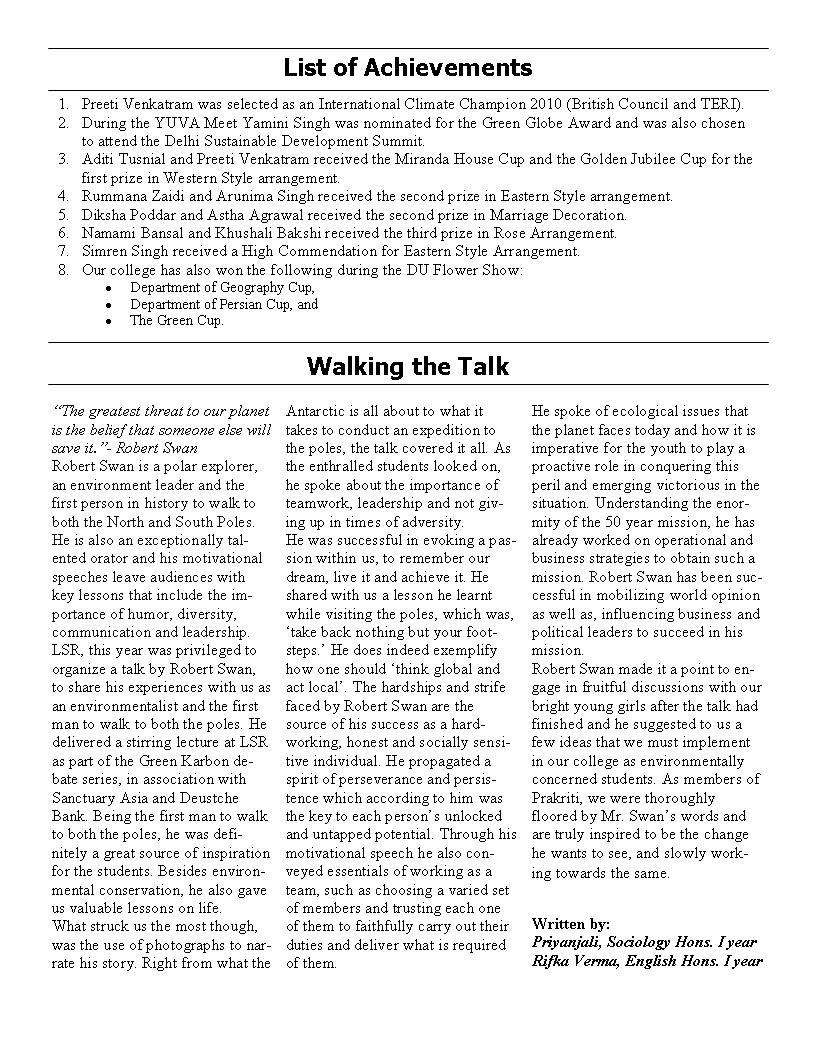
Ankur - The Annual Prakriti Newsletter for 2010-11 is finally out!!! Given below are the first 5 pages of the newsletter, browse through them and dont forget to check out the section dedicated to Prakriti Week! You can click on the pictures to see an enlarged version of the page. Btw...I designed it :D Pg 6,7,8,9,10 are given in the following blog post, as all the pgs could not come on one blogpost!
Ankur - The Annual Prakriti Newsletter for 2010-11 is finally out!!! Given below are the last 5 pages of the newsletter, browse through them and dont forget to check out the section dedicated to Floods and our Mosaic of pictures! You can click on the pictures to see an enlarged version of the page.  Pg 1,2,3,4,5 are given in the above blog post, as all the pgs could not come on one blogpost!
Prakriti- The Environment Society of Lady Shri Ram College Presents "Prakriti Week" from 21-26 March 2011!
• 21st March: Tree Plantation (intra-college)
• 22nd March:
Environmental Quiz-12:30 pm (inter-college)
1. Each participating team must consist of 2 members.
2. Cross college teams are allowed.
3. The first round will be a written round with Multiple Choice Questions. The top eight teams will qualify to the next round and will be contesting in the quiz.
4. The quiz essentially will be questioning you on environmental issues, environmentalists, global networks supporting the cause of the environment, etc.
5. Prizes worth Rs.3,000 to be won.
Each team is required to register on or before 21st March 2011 by filling out the following: https://spreadsheets.google.com/viewform?formkey=dGpCWXBkSzNYcWs1eVZmV2ZaTVdNdlE6MQ
Eco Friendly Folder Making Competition-12:30 pm (inter-college)
1. Participation maybe either in the form of a team of 2 or an individual.
2. A set of two folders has to be made on any one of the themes given below. Each folder should have a different design or pattern.
• Cartoon
• Traditional
• Natural
3. Each folder should be of A4 size.
4. Only handmade paper can be used.
5. Drawing/ painting/ decoration has to be done on the spot.
6. You will be required to bring any material you require- handmade paper folders, scissors, paints, etc.
7. The decision of the judges will be final and binding.
8. Prizes worth Rs. 1,800 to be won.
Each team is required to register on or before 21st March 2011 by filling out the following: https://spreadsheets.google.com/viewform?formkey=dFFQZWRRcTBFN2pJd3pJdTZDUDJjeXc6MQ
• 23rd March: Green Ad Mad Competition- 3 pm (inter-college)
1. A team of 2 or maximum 3 members can participate.
2. The competition will consist of 2 rounds.
3. Preparation time before each round will be given.
4. Different forms of expression can be used- skit, jingles, slogans, or any other innovative form.
5. Time duration to present each act is 3 minutes.
6. The decision of the judges will be final and binding.
7. Prizes worth Rs. 3,000 to be won.
Each team is required to register on or before 21st March 2011 by filling out the following: https://spreadsheets.google.com/viewform?formkey=dE5PRUMxMThnVGFLRDRtOG5yY0xKM1E6MQ
• 24th March: Panel Discussion: 'Climate Change is an Exaggerated Concern'- 11:30 am (inter-college)
• 25th March: Film Screening (intra-college)
• 26th March: Lady Shri Ram Model Conference of the Parties (LSR MCOP)- 9 am (inter-college) http://www.facebook.com/event.php?eid=157058624348045&pending#!/event.php?eid=202974346386758
• Photo Story Competition: Theme- Environment and Growth: Contradictory or Complementary? (inter-college)
1. Only one photo story submission per participant is allowed.
2. Each photo story must have 3 photos in it.
3. Photographs must not be digitally altered in any way (only cropping is allowed).
4. Size of each photograph should be 6" x 8".
5. Each photograph in the story should have a caption and the name, college, course, and contact details of the participant clearly mentioned behind each.
6. Please send all your entries together, enclosed in an envelope to
Faculty Apartments # 21,
Lady Shri Ram College,
Lajpat Nagar 4,
New Delhi- 110024,
India
7. Entries must reach LSR by 24th March, 12 pm.
8. The decision of the judges will be final and binding.
9. Prizes worth Rs.3,000 to be won.
Queries if any can be addressed to lsr.prakriti@gmail.com
|
‘Prakriti’, the Environment Society of Lady Shri Ram College invites applications for the first Lady Shri Ram Model Conference of the Parties (LSR MCOP) to be held on 26th March 2011 during its environment festival, ‘Prakriti Week’ (21st-26th March 2011). http://www.facebook.com/event.php?eid=157058624348045#!/event.php?eid=157058624348045¬if_t=event_wall#wall_posts• Applications are open for the following positions:1. Govern...ment Delegates for the Ad Hoc Working Group on Long-term Cooperative Action (AWG-LCA)
Agenda: ‘Sustainable Development through Adaptation to and Mitigation of Climate Change’
2. Media Delegates (choose one of the three positions):
a) Chief Editor (1)
b) Reporter (3)
c) Photographer (1)
3. NGO Delegates (4)
For whichever delegate position you are applying, please write 250 words on why you want to be a part of LSR MCOP, and what makes you a suitable candidate for the position you are applying for (if you are applying to be a Media Delegate please include relevant samples of your work).
Additionally, please mention previous debating and/or MUN experience. Please note however that we will welcome those with no prior experience as well.
Send in the above (on or before 13th March 2011) to lsr.prakriti@gmail.com along with the following details:
Name, College, Course, Year, Email Address, Phone Number, and Top Three Country Preferences* (in case you are applying to be a Government Delegate)
*Countries:
China, Maldives, Australia, Russia, United Kingdom, Bolivia, Bangladesh, Egypt, Nigeria, Sweden, Saudi Arabia, Canada, Mexico, Indonesia, United States of America, Brazil, South Africa, Haiti, India, Afghanistan, Japan, Chile, United Arab Emirates, Congo, France, Turkey, South Korea, Malaysia, Iran, and Norway.
• Applications are also open for the Executive Board of the (AWG-LCA). It is mandatory for applicants to have had prior Executive Board experience. Knowledge about UNFCCC and Conference of the Parties is also a must. Positions are:
a) Chair
b) Vice- Chair
For whichever Executive Board position you are applying, please write 250 words on why you want to be a part of LSR MCOP, and what makes you a suitable candidate for the position you are applying for.
Please also mention previous debating and/or MUN experience.
Send in the above (on or before 13th March 2011) to lsr.prakriti@gmail.com along with the following details:
Name, College, Course, Year, Email Address, Phone Number
Prizes:
Best Delegate: Rs. 2,000
High Commendation: Rs. 1,000
Special Mention: Rs. 500
Queries, if any, may be addressed to lsr.prakriti@gmail.com.
LSR came alive with vibrant colours and festivity on 1 st November, 2010. The shift from the boring classes to jubilant exultation, was to celebrate the festival of lights i.e. diwali. The traditional festival of lights with its significant message of victory of good over evil was celebrated with great pomp and show. Every year the celebration is earmarked by a small diwali mela organized by the NSS (National Social Service Organization) of LSR. The mela was a happy affair with its assortment of food, games, accessories and the like. The presence of Rajasthan dancer’s, Punjabi dhol and a street play group left nothing else to be desired for. The festive mood was in full swing with every stall thronged by girls dancing either to the tune of Punjabi pop or Eminem rap. Apart from the stall’s set up by the NGO’s under the NSS, the different societies of LSR had also set up their respective stalls.
Entretia, the e- cell of LSR had also set up a stall at the diwali mela. Our stall was placed conveniently in the mela so as to capture more eyeballs, sell more products and hence earn more profit. The item’s exhibited for sale at our stall were cool flat chappals, assorted candies’, cloth bags, eco-friendly and multipurpose vase and customized posters. This was not all as there was also a betting game which required the individual to complete the task without tearing the paper given to the individual. Every member of the e-cell contributed in the successful sale of the items in the stall in their own way. For instance, some had taken up the duty of taking charge of the stall and persuading the customer’s into buying the items for sale at the diwali mela. The items were sold at “customer pocket friendly prices” like one pair of chappals for 130 rupees, bag for 165 rupees, and vase for 15 rupees and so on. This was the primary reason for the voluminous sale of our items at the diwali mela.
This effective pricing strategy helped us in earning profit and increasing the immensity of this festivity. The success of the event should also be attributed to all the members of the e-cell who volunteered and worked as a team under the praiseworthy leadership of the e-cell coordinator’s Smriti and Swati.
| | 


.jpg)